A guide for communities considering whether to host nuclear waste facilities
The federal government is responsible for implementing a program to manage the spent nuclear fuel nuclear waste from commercial nuclear reactors and high-level waste from defense related programs. Spent nuclear fuel is used reactor fuel from commercial nuclear power plants that has been irradiated to the point where it is no longer efficient in sustaining a nuclear chain reaction; therefore, it must be removed and the reactor stocked with new fuel. High-level waste comes from historical reprocessing operations and from the nuclear weapons complex.
This resource is intended to help local officials and community residents think deeply about the ramifications of hosting a nuclear waste facility and to engage more effectively with federal and state agencies in a decision-making process, thereby empowering your community to engage as productively and effectively as possible and to make decisions that are right for its residents. This set of webpages only addresses spent nuclear fuel and high-level radioactive waste from commercial and defense-related activities.
This website is structured with several parts:
An overview of the current policy context that motivates the need for a website like this to help communities navigate their engagement with federal and state decision makers
The importance of a consent-based siting process to ensure meaningful community engagement and power to make decisions;
Questions the community should consider about the trustworthiness of the process and federal and state agencies
Guidance on the kinds of risks and benefits that a community should consider as they consider whether to participate in a process about hosting a nuclear waste facility;
The capacities that a community will need to engage effectively in a process about hosting a nuclear waste facility;
A webpage listing additional resources.
This project was funded under a DOE contract. At that time, the DOE was developing a consent-based approach for nuclear waste storage facilities. This idea has been guiding US policy since the Obama Administration. This is also sometimes referred to as giving communities or Tribes “the right to withdraw” or requiring that communities express “willingness to host” before a facility can be sited. Ensuring communities have a ‘right of withdrawal’ and overt form of final approval over siting of a facility is an important legal and psychological precondition for active participation in a siting process. Other democratic countries that are looking for nuclear waste disposal sites have based their efforts on the concept of free, prior, informed consent when seeking a host community for spent nuclear fuel and high level waste.
-
This website was created with funding that originated under the Biden Administration and was carried on during the second Trump Administration. The funding was part of a program to develop a consent-based siting process for nuclear waste facilities as part of an integrated waste management strategy. The Trump Administration has backed off from this approach and is adopting a different strategy. Our funding supported work to learn from communities about their needs and preferences for a consent-based siting process and to package that learning into advice the U.S. Department of Energy or another organization could use to best engage with communities about possibly hosting a consolidated storage facility (CSF) for high-level nuclear waste.
In preparation of this document, we have:
Talked to dozens of community leaders, officials, citizens, and stakeholders across the USA to learn what they want to know about how to participate effectively and how they want to find it out.
Drawn upon lessons learned from past efforts to site hazardous facilities, including nuclear waste facilities.
Drawn upon our three decades of experience conducting research on public participation, assessment of technological risks, and nuclear waste management in the US and around the world.
During the project period, however, a shift occurred. The current Administration substituted the term collaboration-based siting in place of consent-based siting. This reframing introduced some ambiguity as it is not yet clear what operational meaning "collaboration" carries in this context. Namely the question remains whether it preserves a local veto or whether it represents a shift in the locus of decision-making authority away from affected communities and toward state or federal government. Our recommendations are offered under the assumption that affected communities will need to consent to hosting any facility before it can be built. We believe that no community or Tribe or state should be forced to accept a nuclear waste facility that it does not want.
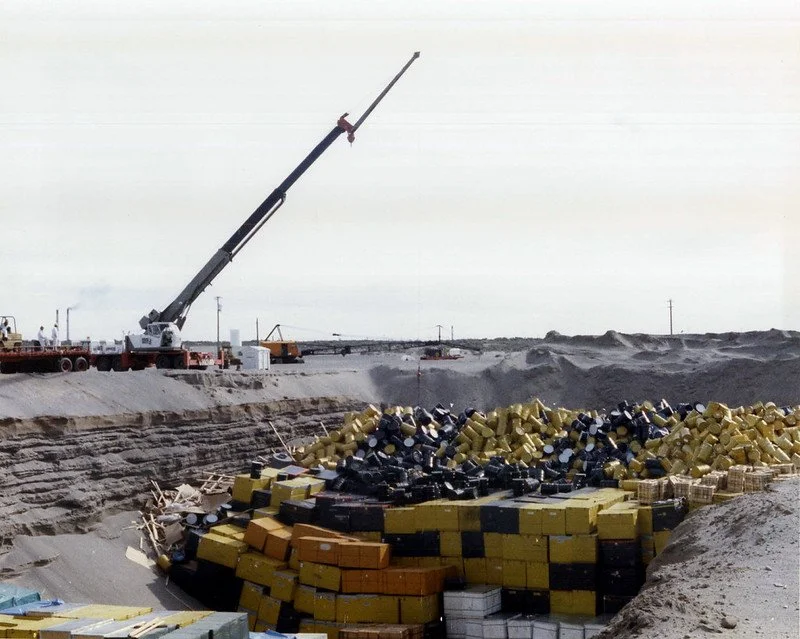
Commercial Low-Level Waste Site in Washington – 1991. Source: Nuclear Regulatory Commission
-
All other countries with nuclear reactors are committed to building Deep Geological Repositories (DGRs) to permanently house their wastes. Every country and international nuclear body (NEA, IAEA) agrees that this is the best way to permanently “manage” these wastes. Finland is the furthest along. It has constructed a DGR and is in the final phase of licensing it. Sweden has started constructing its DGR. Switzerland and France have each found sites and are in the first stages of getting a license to start construction. Canada selected a site in 2024. Korea, Japan, Spain, Belgium, United Kingdom, Germany, Czech Republic, and Italy are in the process of looking for a site. Other countries, including the United States, have not begun a process to find a site.
The fundamental value of informed consent
This Guide is based on the belief that informed consent should be a fundamental value in efforts to locate host communities for nuclear waste facilities. The concept of consent has important implications for how a community should engage in a process about siting of a waste facility:
A potential host community should have to volunteer to begin a conversation about hosting a facility.
The process should be designed to give potential host community the resources and time needed to reach its own full understanding of the expected and possible benefits and risks.
Communities interested in exploring the possibility of hosting a nuclear waste facility should be supported to develop sufficient capacities to engage as equals in dialogue with other parties in this process, as opposed to simply being “educated.” Capacity-building is foundational to communities having real agency. Those capacities should be built with the support (financial and other) from the DOE or the siting organization.
The DOE or the siting organization responsible for implementing the process should adopt a regional approach such that the potential host community works in partnership with neighboring communities and collaborates with Tribes and states.
The community must be able to withdraw from the process. The “right of withdrawal” must be explicit, legally durable, and understood by communities before entry into the process. It is not symbolic — it is a psychological and political precondition for participation.
No facility should be sited or built without the host community’s free, informed consent.
The host community should have the ability to negotiate a Community Benefits Agreement (CBA) with the DOE or the siting organization before the final decision is made.
The potential host community should be involved in the design, monitoring, and operation of the facility.
This website was created with funding from the US Department of Energy.