Consider the trustworthiness of the process and federal and state agencies
It is vital that the community strive to understand the goals, plans, limitations, and abilities of the federal government agencies and state government agencies that are likely to play pivotal roles in any siting process.
Can the community be assured that federal agencies will be good partners?
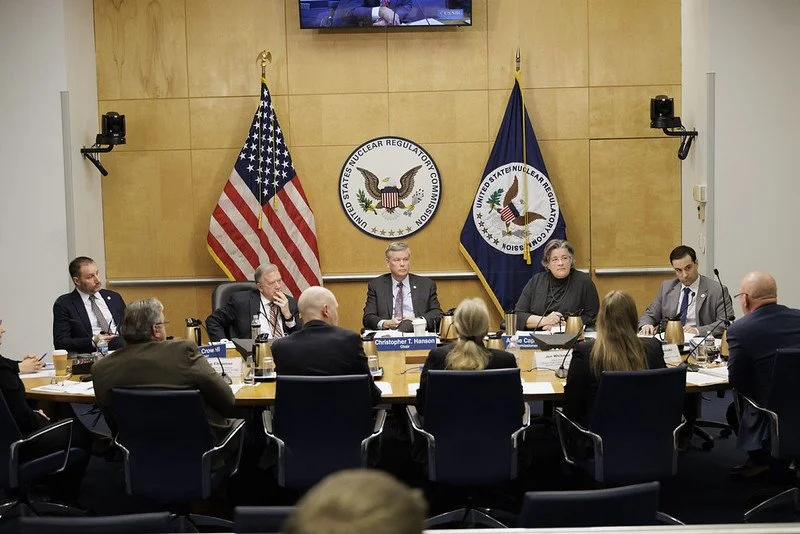
The NRC Commission holds its first Commission meeting with Commissioner Marzano in attendance. Source: Nuclear Regulatory Commission.
The agency with primary responsibility for planning, designing, and operating waste facilities for SNF and HLW is the Department of Energy. The Nuclear Regulatory Agency, Department of Transportation, and Environmental Protection Agency will also play important roles. The history of efforts to develop a system for managing SNF and HLW has been fraught and raises legitimate questions about whether the federal government can be a reliable partner. As you and your community make up your own mind about whether or how to work with federal agencies, consider the following questions.
-
The short answer is that we do not know. released a. Request for Information on Establishment of Nuclear Lifecycle Innovation Campuses released by the Department of Energy in January 2026 asks states to propose “nuclear campuses” and that “waste disposition” must be part of any state’s plan. “Waste disposition” can include storage of wastes (consolidated storage sites) and disposal in a deep geologic repository, but it can also mean other processes such as reprocessing/recycling of spent nuclear fuel.
-
At this time it is not clear what sort of community engagement or decision process the DOE is requiring or expecting, but it appears that DOE might be expecting the state to run the community engagement process. The Request for Information released by the Department of Energy in January 2026, “Request for Information on Establishment of Nuclear Lifecycle Innovation Campuses” identifies public participation as a key to success and requires a “stakeholder engagement plan” to be part of any response to the Request for Information, however, it does not specify any performance goals or requirements that the plan must meet.
Communities, states, or Tribes interested in considering the opportunity to host waste facilities as part of DOE’s new program should make themselves familiar with the DOE’s RFI as well as earlier proposed consent-based siting process. Some high-level questions to consider are:
Will the DOE or the state require specific features or activities for a process with communities?
Will the DOE let state’s determine processes for engaging communities about hosting facilities?
Will the community have the right to say “yes” or “no” to hosting a facility and have that decision respected by the federal and state governments?
What is the timetable for the community engagement process?
Who determines who gets to participate and how, including whether affected communities or Tribes have a role in the process?
Will the federal government or the state distribute funds to support community involvement?
What role might a community, Tribe, or state play in designing or monitoring a facility?
-
The question of whether the DOE can be a trusted partner is a central concern that communities working with DOE have wrestled with for decades. The history of nuclear waste management in the United States demonstrates why. The federal government has not followed through on its commitments. The 1982 Nuclear Waste Policy Act set out a process for selecting and siting deep geologic repositories and a system for managing SNF and HLW. The Act was based on four commitments:
To plan for two deep geologic repositories, with likely locations in the eastern and western United States, to address concerns about geographical equity;
The selection of sites and their assessment would be technically driven;
The federal government would begin, in 1998, to dispose of SNF from commercial power reactors (because it was assumed that a repository would be operating by then) in exchange for fees paid by utilities;
States being considered for deep geologic repositories would have a meaningful role in the siting process.
All of these “bargains” have been violated by Congress. By 1987 Congress passed amendments that pre-emptively selected the Yucca Mountain site in Nevada without due consideration of other options. Today, the nation is without a facility to store the SNF and HLW and the federal government is in violation of the obligation to begin disposing of wastes from utilities by 1998.
Now, the policy and regulatory environment is evolving again. The DOE under the current Administration has shifted its approach to siting from a consent-based to a collaboration-based siting, broadened consideration of waste management to include reprocessing, and appears to be giving states a leading role in determining where waste management facilities will be located. The role of Tribes in the new process is also unclear.
The history has led many inside and outside of DOE to acknowledge that the agency suffers from a lack of public trust. While DOE has made mistakes in some of its community engagement, it is also important not to condemn DOE for violating promises without recognizing the limitations placed on DOE by the Congress or the Administration. A community needs to be aware that the President or Congress may change policies and plans abruptly; it is not always the DOE that is at fault for shifts in the direction of nuclear waste management policy.
A good question for the community to consider is how to proceed in a context of distrust?
-
The Nuclear Regulatory Commission (NRC) was established by Congress in the 1970s. It is responsible for permitting and regulating all radiological aspects of nuclear power plants, including the fuel manufacturing and the waste streams. Prior to the establishment of the NRC, the Atomic Energy Commission was charged with promoting and regulating nuclear power. In the late 1970s, Congress determined it would be better to separate these two activities. It established the NRC as an independent (non-political) regulatory body. Its independence was intended to earn public trust – as a competent, unbiased, regulator. The DOE was established at the same time and given the job of promoting nuclear power. The DOE is also responsible for building and maintaining the effectiveness of nuclear weapons and cleaning-up sites that were contaminated during the development, manufacture, and testing of nuclear weapons.
The Environmental Protection Agency is generally responsible for setting environmental standards, as instructed by federal laws. For a deep geological repository, EPA is responsible for setting the environmental standards and NRC uses those standards when it conducts its license approval process. The DOE is then charged with operating the facility. DOE is not a regulatory agency, although it does set regulations for its experimental reactor program at DOE Lab sites.
When it comes to consolidated storage of SNF and HLW, EPA would have a smaller role and NRC would be the primary regulator, ensuring that EPA’s radiation protection standards are met.
Communities hosting nuclear waste storage facilities should be concerned with the competence and trustworthiness of these regulatory agencies. They should understand that DOE’s job is to promote nuclear power, not to regulate. Safety standards, inspections, fines, and corrective actions would be determined by the Nuclear Regulatory Commission. They should consider whether the regulatory agencies are acting on the basis of the best available science.
In 2025 President Trump signed an Executive Order instructing the NRC to overhaul its regulations and regulatory processes and more rapidly approve new nuclear technologies and power plants. Importantly, the Executive Order also instructed the NRC to re-examine the long-held assumptions about the danger of low doses of radiation that have guided safety regulations for decades.
Certainly, the President and Congress are entitled to change policies, laws, regulations, and programs. Regulations should also keep up to date with changing technology and scientific discoveries. It is possible that a new law may be passed that creates a new organization and regulatory framework to plan, design, license, construct, and manage the nuclear waste system. Communities need to be up to date with these changes and reach their own conclusions about whether they feel these agencies are sufficiently protecting public health while also allowing a nuclear industry to prosper.
-
An agreement between the host community and DOE should be required before any nuclear waste facility is sited, built, and put into operation. Such agreements are intended to protect both parties, however, if DOE were to violate the agreement, perhaps because of a change in federal policy or law, would the community have the resources to sue the federal government? If the answer is “no” then communities should think about securing the cooperation of the state to ensure the DOE meets its contractual obligations.
-
Mission creep is when a stated mission gradually changes until the mission itself has evolved into something new. For instance, an interim storage facility might evolve into a permanent disposal facility or a waste reprocessing facility. Mission-related changes ought to be clearly noted and discussed. Communities may want to specify community engagement and decision-making processes that will be required before any changes to the contract or agreement can be made final.
Can the community be assured that state agencies will be good partners?
Federal law gives the authority for regulating radioactivity to the federal government. States cannot regulate nuclear power or nuclear waste, with some exceptions for medical and low level radioactive wastes. States cannot prohibit the siting of nuclear facilities on the basis of radiation. However, states often have influence in siting decisions. Influence refers to a form of power that is not authorized by law. In other words, political power. This is evident in Nevada’s opposition to Yucca Mountain, Utah’s opposition to Private Fuel Storage on the Goshute Tribe’s Reservation, and the more recent opposition by the states of New Mexico and Texas to private SNF storage facilities in their respective states. In all four of these instances, siting of nuclear waste storage facilities was halted by states that did not have the legal authority to prohibit the facility, but that marshalled political influence.
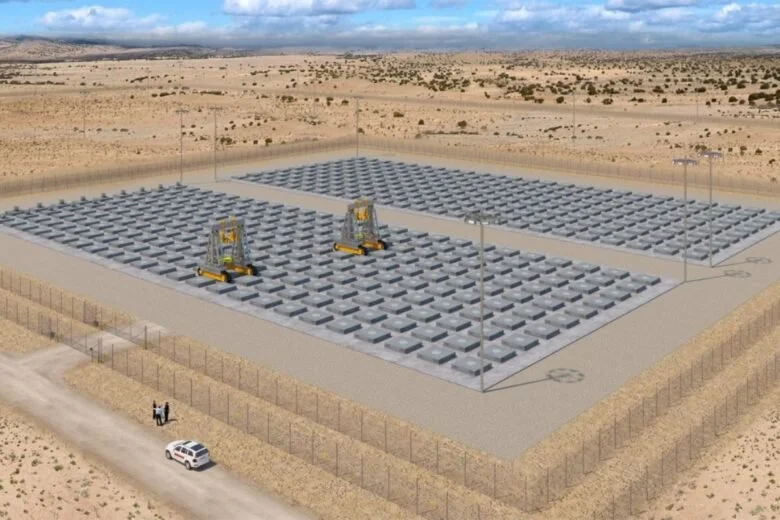
Pictorial view of the New Mexico HI-STORE Consolidated Interim Storage Facility (Holtec). Source: New Mexico Political Report
The recent decisions by the Department of Energy appear to be expanding the role of states and creating additional incentives for them to host waste facilities (Request for Information on Establishment of Nuclear Lifecycle Innovation Campuses). Communities that are receptive to hosting nuclear waste may find states to be powerful allies or opponents. States differ widely and at present many states are embracing nuclear power and some show interest in reprocessing nuclear wastes.
Some high-level questions to consider are:
Will the state require specific features or activities for a process with communities? Are they adequate to ensure the community’s power in the process?
Will the community have the right to say “yes” or “no” and have that decision respected by the state government?
What is the timetable for the process?
Who determines who gets to participate and how, including whether communities or Tribes neighboring the host community have a role in the process?
Will the state government distribute funds to support community involvement?
What role might a community play in designing or monitoring a facility?
-
What does your community want from your state legislature or state agencies and how will it define the quality of the partnership? Do you want state partners who will promote nuclear facilities? Do you want state partners who will provide strong oversight of federal agencies? Are you looking for technical assistance from your state? Do you need help with economic development? Can you find ways to bring state funding into your community or region so that there is broad investment in the facility?
-
Changes in state administrations can often mean changes in policy. How will your community cope with sudden changes in policy? What would help increase your confidence in state leadership’s commitments to the community and policies related to nuclear waste? Do you need to have a “Plan B?” Are there legal mechanisms that can help to ensure that promises made by states are kept?
-
Communities may benefit from having another pair of eyes scrutinize plans for the construction and operation of a nuclear facility. It may fall on the shoulders of the community to reach out to state officials and find the expertise that is needed. Thirty-nine states are “NRC Agreement States” meaning that they have signed agreements with the NRC to regulate some radiological materials. This generally includes medical isotopes and wastes, but never SNF or HLW. However, agreement states have to employ staff with knowledge of nuclear science. These people may be good resources for you.
Managing funding from the federal government may be a task that is beyond the capacity of some local governments. Communities may find value in having local Councils of Government or states serve as intermediary partners in managing federal funds.
-
An agreement between the host community and DOE should be required before any nuclear waste facility is sited, built, and put into operation. Such agreements are intended to protect both parties. If, after an agreement between the DOE and your community is signed, your state implements new policies, laws, or regulations that impact the construction or operation of the facility, could your community be left with liabilities? This could happen if states were to impose restrictions on water use, emergency planning, transportation, or other non-radiological factors. Communities should work closely with states to ensure they are protected from these unexpected liabilities.
This website was created with funding from the US Department of Energy.